
Food is a substance consumed by organisms for nutritional support, usually of plant, animal, or fungal origin. It contains essential nutrients such as carbohydrates, fats, proteins, vitamins, and minerals.
Essentially, food’s characteristics have been shaped by factors like ethnicity, alluvial soil, and climate, which relate to cultural diversity, geography, and individual preferences.
Are you a food enthusiast eager to explore diverse tastes during your trip to Nepal? Certainly, Nepal offers a wide range of Nepali cuisine, from street food to authentic local dishes. The country’s rich cultural diversity, alluvial soil, and climate-related variations significantly influence Nepali food throughout the region.
A typical Nepali dish that locals commonly enjoy is ‘Dal Bhat Tarkari’. The popular saying, ‘Dal Bhat power, 24 hours,’ reflects the fact that many Nepali people are engaged in labor-intensive occupations such as agriculture and portering. Dal Bhat and Tarkari provide them with the necessary carbohydrates for such demanding work. However, with Nepal opening its doors to foreigners in the 1950s and technological advancements, Nepali cuisine has also been influenced by neighboring countries like China (Tibet) and India.
Numerous Tibetan and indian foods and dishes have become integrated into Nepali daily life. During your trip to Nepal, you can easily find a variety of options, ranging from spicy curries to lighter, less oily dishes. The trend of vegetarianism is also growing, making vegetarian food easily accessible.
This article explores various food varieties that you should definitely try while in Nepal.
Kodo ki Roti (Ragi)

Kodo ki Roti, a Nepali bread, is famously known in Nepal. It is also referred to as Ragi (ra·gi), an ancient cereal staple crop notably cultivated in India and Africa. The term originates from Deccan Hindi “rāgī.”
Are you interested in experiencing Ragi (kodo ki Roti) in Nepal? You can savor this delicacy in various places, ranging from remote villages to restaurants across Nepal. Ragi, also known as kodo or finger millet, is a finely ground type of grain that is small and round in shape.
This grain boasts numerous varieties that can be found worldwide, totaling an estimated 6000 variations in colors. Millets are gluten-free and packed with essential nutrients such as B vitamins, calcium, iron, potassium, magnesium, and zinc. The bran layers of millets serve as excellent sources of B-complex vitamins.
During your trip to Nepal, be sure not to miss out on tasting Kodo ko roti.
Samay Baje

Similar like Dal Bhat but culturally distinct ‘Samay Baje’is traditionl Newari meal that offers you a unique dishes that reflect their historical way of life. In the past, without modern amenities like electricity and gas, cooking relied on burning wood logs, leading to two daily meals. Breakfast wasn’t a norm back then in Nepal.
Since Newari people used to stay in clustered homes, far from their farms. They walked an hour daily to reach the fields, carrying snacks like “Chyura,” “Chhwela,” “Bhatamaas,” “Palu,” and “Saag” for midday sustenance. These snacks were both flavorsome and nourishing.
“Samay Baji,” a highlight at Newari festivals, features dried beaten rice paired with bean curries, soybeans, pickles, meat curries, and a crispy egg. It’s enjoyed year-round during auspicious occasions like Indra Jatra, Dashain, and Tihar, becoming a core part of Nepal’s food scene.
Authentic “Samay Baji” experiences can be found at Newari homes or festivals and restaurants. The term “Newari set” or “Newari khaja” on menus often represents this dish. Notably, Newa Lahana in Kirtipur is renowned for Newari cuisine.
Momos

Momo, a type of steamed filled dumpling, is a staple in Tibetan and Nepali cuisine. It can be enjoyed steamed, fried, or in a hot soup. The term “momo” originates from the Tibetan word ‘mog mog,’ where ‘mo’ means wheat flour food products. In Nepali, the word “mome” signifies cooking through steaming. The roots of momo in Nepal trace back to the fourteenth century, having strong ties to Tibetan and Nepali culinary traditions.
Crafted from a mixture of white flour and water dough, momos encase a filling of meat or vegetables. These ingredients make up the core of this delectable treat, providing a substantial energy source ranging from 35 to 100 kcal per piece. The momo comes in various delightful variations, including Steam-momo, Kothey momo, Jhol momo, C-momo, Fry-momo, Open-momo, fried momo, chicken-momo, veg-momo, buff-momo, cheese-momo, khuwa-momo, and even chocolate-momo. Gaining popularity not only in Nepal but also in neighboring countries like Bhutan and India, momos typically arrive in servings of eight, 10, or 12 on a plate. However, specific regions offer their own twists. In higher-altitude areas, the dumplings often take on a larger form
Sel Roti

Sel Roti is a special snack enjoyed in Nepal, especially during festivals like Tihar and Dashain. It’s made by frying a circular bread made of rice flour until it’s crispy outside and soft inside. This treat is a bit sweet and tastes great with yogurt or veggies. It’s a must-try during Nepalese festivals and is popular in Nepal.
Dhindo
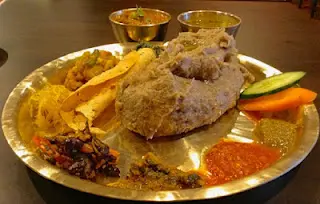
Dhido holds deep cultural significance in Nepal, particularly in rural regions. This traditional dish, crafted from buckwheat, millet, or corn flour, is cooked by stirring the mixture over heat until it forms a thick, dough-like consistency.
The cooked dhindo is typically shaped into balls or mounds and served with sides like local vegetables, lentils, and meat curries. Its hearty nature makes it a staple in many regions, offering both sustenance and satisfaction.
Beyond its nutritional value, dhindo symbolizes Nepali tradition and heritage. Sharing a dhindo meal with loved ones fosters togetherness, reflecting the simplicity of local living.
In the heart of Kathmandu and Thamel lies a hidden delicacy: Dhindho or Dhido Thali. This thick porridge is created by boiling stone-ground cornmeal, buckwheat flour, and millet flour with salted water. It’s a rural staple, often enjoyed with butter, vegetable curries, pickles, buttermilk, and yogurt. Dhindo embodies the essence of Nepali culture, history, and community values.
Thukpa

Thukpa is a popular Nepali dish with Tibetan origins, loved for its comforting and flavorful qualities. It’s essentially a noodle soup that has become a staple in Nepali cuisine. Thukpa is made using boiled noodles, vegetables, and often includes meat such as chicken, pork, or beef. The broth is usually seasoned with a mixture of aromatic spices and herbs.
The dish is not only delicious but also versatile, with variations in ingredients and preparation methods across regions and households. In some versions, thukpa might include fresh greens, bell peppers, carrots, and cabbage. It’s known for its warming and nourishing qualities, making it especially popular in colder weather.
Thukpa has gained popularity in Nepal due to its heartiness and adaptability. It’s a go-to comfort food that’s enjoyed in many households and is also commonly found in local eateries, tea shops, and street food stalls. Whether enjoyed as a light meal or a more substantial option, thukpa remains a beloved dish that showcases the fusion of Tibetan and Nepali culinary influences.
Thakali Khana

Thakali Khana comprises a serving of rice or dhido paired with seasoned lentils, sautéed greens, gundruk ko achaar, assorted pickles, and both vegetarian and non-vegetarian curries, all elegantly presented on a single platter. Enhancing the experience is the addition of melted ghee over the rice or dhido. While resembling Dal-Bhat, Thakali Khana distinguishes itself through distinct cooking methods and ingredients.
As the popularity of Thakali Khana grows steadily in Kathmandu, you can savor this delectable dish in various restaurants across Nepal. For an authentic experience, Thakali Kitchen, nestled in a charming garden setting, is the ideal spot. Located in Thamel, it promises an exquisite journey into the flavors of Thakali cuisine.
Yomari
